Construction & groundworks marketing
Fewer enquiries. Considerably bigger ones.
Construction, groundworks and surfacing do not behave like domestic trades. Search volume is thin, cycles run for months and the buyer is assessing credibility rather than comparing prices. Campaigns built for volume fail here; campaigns built for precision work.
In short
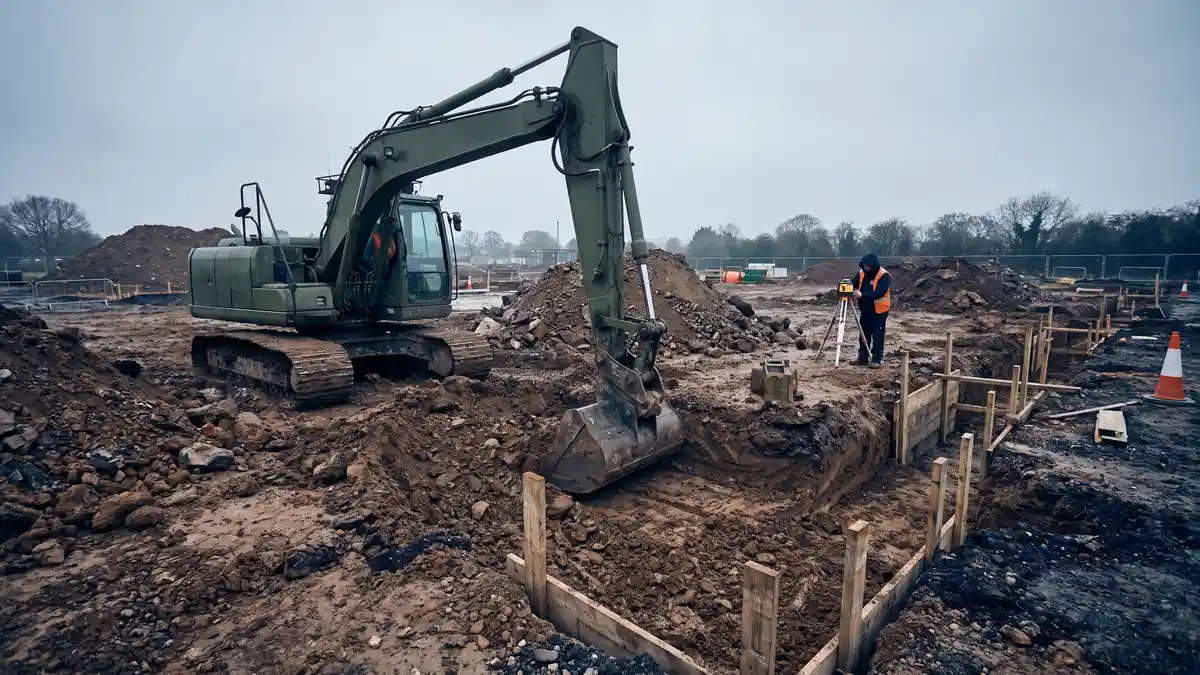
Construction and groundworks marketing in the UK is a long-cycle, high-value game, which changes what advertising is for: the job is to be on the shortlist when a tender or a private client starts asking around, not to collect cheap enquiries. Average contract values run from tens of thousands upward, close rates are low, and a single won job can pay for a year of advertising, so cost per lead is close to meaningless and cost per won contract is the only number worth tracking. The biggest waste is recruitment traffic and people looking for construction courses, CSCS cards or labouring work. Credibility does most of the conversion here, so accreditations, insurance levels, named past projects and case studies matter more than ad copy does.
Precision over volume
In domestic trades you can afford some waste, because volume smooths it out. In groundworks, where a contract might be worth £80,000 and there may be forty relevant searches a month in your county, waste is the whole budget.
So construction campaigns are built inverted. Extremely tight keyword sets, almost entirely exact match. Aggressive exclusion of domestic intent, DIY intent and job-seekers. Wider geography, because the buyer is a business and travel is already priced into the contract. And a willingness to spend more per click, because a click from a commercial developer is worth many times one from a householder.
What a commercial buyer checks
A main contractor or developer landing on your site is answering a different question to a homeowner. Not “how much”, but “can these people actually do this, and is engaging them a risk to me”. Which means the site has to show, without being asked:
- Completed projects of comparable scale, with values and durations
- Accreditations — CHAS, Constructionline, SafeContractor, ISO where held
- Insurance levels stated plainly
- Plant, capacity and directly employed headcount
- Health and safety record
- Named people with real experience, not stock photography
Most construction websites have a gallery and a phone number. That is fine for a householder and thin for a buyer placing a six-figure package.
The measurement problem, handled honestly
If the cycle is six months, a ninety-day review will show cost per enquiry and almost nothing about return. That is a genuine limitation, and the answer is to track through the CRM: enquiry, then opportunity, then tender, then contract, each tied back to the source. It takes discipline and it is the only way to know whether the channel is working rather than guessing at the end of the year.
What we set up for construction firms
- Exact-match campaigns on specific disciplines
- Hard exclusion of domestic and job-seeker intent
- Wider geography, higher bid tolerance
- Credibility-led landing pages, not price-led
- LinkedIn-aware brand presence for named searches
- CRM tracking through the full cycle
- Service-specific SEO on low-volume, high-value terms
Construction firms we have worked with
Dohme Developments · Surfacing R Us · Lines R Us · BRS · Renewlec UK
Dohme Developments
Google Ads at roughly a 14% conversion rate and a 4.51% click-through rate over a 40-day window, with Meta contributing around 16 leads a month alongside it, and a CRM handling follow-up. Full numbers →
Construction marketing questions
Is there enough search volume for construction and groundworks?
Less than in domestic trades, and that is the central constraint. ‘Groundworks contractor [county]’ might be searched a few dozen times a month rather than a few hundred. The compensation is value: one contract can be worth more than a year of domestic work. Campaigns are built for precision rather than volume, and success is measured in a handful of good enquiries, not dozens.
How do you market to commercial buyers rather than homeowners?
Different search terms, different landing page and different proof. A commercial buyer is checking whether you are credible and capable, not comparing prices in a spreadsheet. That means accreditations, insurance levels, health and safety record, plant and capacity, and completed projects of comparable scale — visible without having to ask.
What about tender and framework work?
Search advertising is not how frameworks are won, and we would not pretend otherwise. What the website can do is support it: when a buyer or a QS searches your company name after receiving a submission, what they find shapes their view. A credible, current site with real projects and accreditations is doing quiet work at exactly that moment.
Should a construction firm bother with SEO?
Yes, on specific service and area terms rather than head terms. ‘Construction company’ is a hopeless target. ‘Reinforced concrete frame contractor Hampshire’ or ‘S278 highways works [county]’ is very winnable, low volume, and every search is a serious buyer.
How long is the sales cycle?
Commonly three to nine months from first contact to contract, occasionally longer. That has a real consequence for measurement: judging a campaign at ninety days will understate it. We track enquiries to opportunities to contracts in the CRM so the picture reflects the actual cycle rather than the reporting month.
Related
Talk to a human
Chasing commercial work?
Tell us the disciplines and the region. We will tell you honestly whether there is enough search demand to build a campaign on.