Results
Campaign numbers we can open the account and prove
Every figure below comes from a live advertising account managed by Marcus. We have deliberately included cost per conversion and click-through rate rather than only the flattering totals, because a big conversion number on a huge budget means nothing on its own.
In short
Measured advertising results published by PipelineOS come from scaffolding, roofing, glazing and surfacing campaigns run by Mecosse, the sister agency, with the original campaign names left visible in the screenshots rather than cropped out. Results are not claimed for the sectors where the site carries research and method instead, and those pages say so.
Case study — scaling a Google Ads account from a standing start
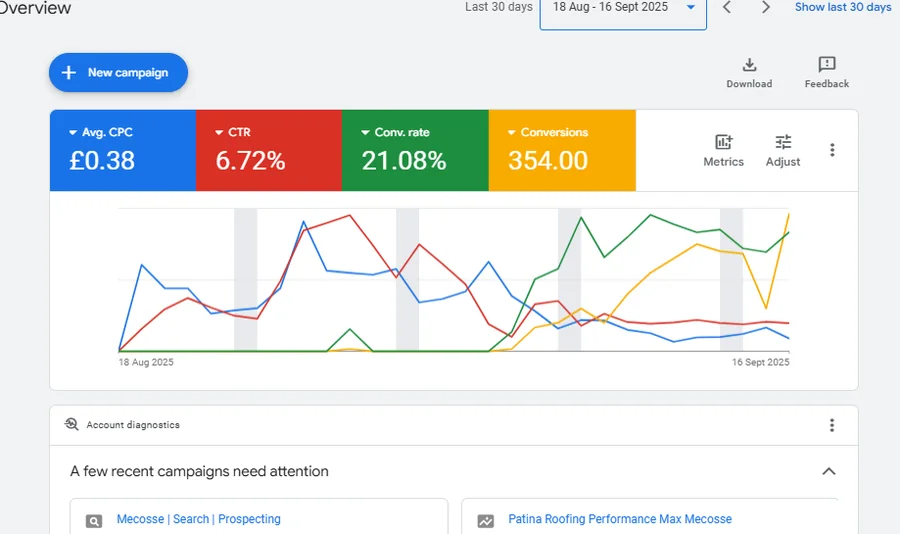
Each of those 354 conversions is a phone call or a completed contact form, not an impression or a page view. A 21% conversion rate on search traffic is high because the campaign was deliberately narrow: high-intent keywords only, tight geography, and a negative keyword list built weekly from the actual search terms report. Broad-match campaigns in this sector routinely convert at 3–5%.
The account did not start there. It compounded — small budget, tight targeting, weekly search-term pruning, then budget increases only once cost per conversion held steady.
Individual account snapshots
| Channel | What it produced | Efficiency | Why it matters |
|---|---|---|---|
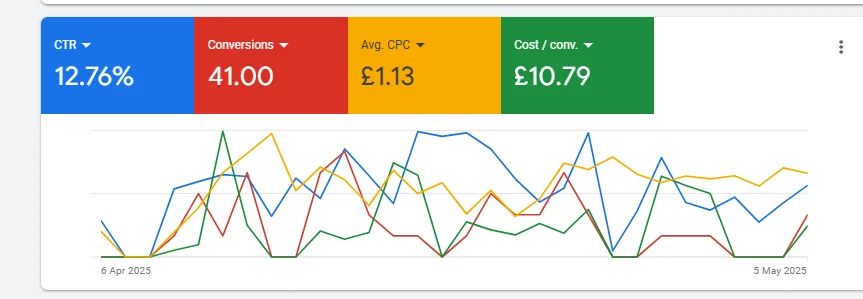
| Google Ads | 41 conversions | £10.79 cost per conversion, 12.76% CTR | Roughly £11 to generate an enquiry in a trade where a single job frequently clears four figures. |
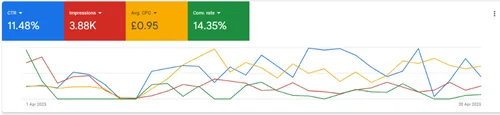
| Google Ads | 3,880 impressions | 11.48% CTR, £0.95 average CPC | Sub-£1 clicks in a competitive vertical — the result of relevance, not luck. Cheap clicks come from good ads on tight keywords. |
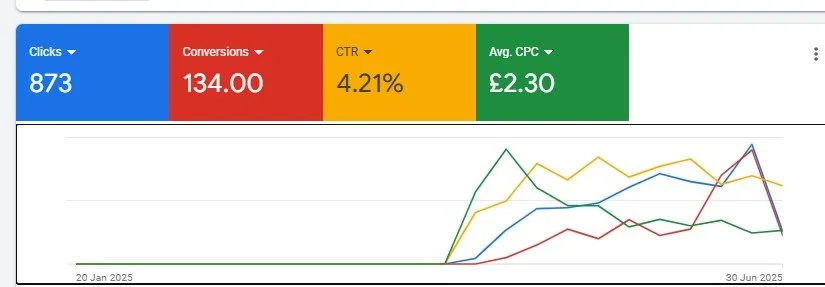
| Meta Ads | 873 clicks, 134 conversions | £2.30 average cost per click | A 15% click-to-conversion rate on social traffic, which is cold audience — these people were not searching. |
| Google + Meta combined | 16 leads/month from Meta alongside search | ~14% conversion rate, 4.51% CTR on Google Ads over 40 days | Dohme Developments. Search captured existing demand; Meta topped up volume when search inventory ran dry. |
All figures on this page come from live advertising accounts managed by our founder. Screenshots are available on request — we will not show you a number we cannot open the account and prove.
The Dohme Developments walkthrough
Rather than write it up, here is the account on screen. Google Ads at roughly a 14% conversion rate and 4.51% click-through over forty days, Meta contributing around sixteen leads a month, and the CRM automating the follow-up.
What clients say
Within the first month I have been seeing better results from his SEO work than I saw from the previous year in its entirety.Trustpilot, January 2026 · read it
Marcus at Mocosse has been doing a smashing job on our website, seo and ads already made my money back within 2days of running adverts with him.Trustpilot, November 2025 · read it
Quick and very skilled, couldn’t recommend enough got me from a couple clients to completely fully booked in a month!Trustpilot, August 2025 · read it
Reviews left for Mecosse, the agency Marcus founded and still runs. PipelineOS is the same operator and the same client accounts. All ten reviews, in full and each linked to the original, are on the reviews page.
Firms we have run campaigns for























Also worth reading
- Check what AI says about your businessA free audit you can run yourself in ten minutes.
Talk to a human
Want to see the accounts?
We will screen-share a live account on the call. It is the fastest way to tell whether an agency is quoting real numbers or stock ones.
Reading the evidence
How to interrogate an advertising screenshot, including ours
Screenshots are the standard currency of this industry and close to worthless without context. Apply the following to the images above this section as readily as to anybody else's.
Look at what has been cropped off. A tight crop around a conversion total removes the three things that give it meaning: the date range, the spend, and the account it belongs to. Each omission is a choice, and the honest reading is that the missing number flattered less. Ask for the crop widened, not for a different screenshot.
Check what the conversion is. Platforms will count a page view, a scroll or a chat widget opening as a conversion, because somebody configured it that way. The glossary separates a click from a conversion from an enquiry, and the methodology page gives the definition used here.
Ask whose account it is. Sector, geography and budget order of magnitude are all needed before a number transfers to you.
Watch for the surviving example. Every agency has a best account. Showing it is fine; implying it is typical is not. Ask what an average month looks like and what the worst account did last year. The second answer is the informative one.
Distrust ratios without denominators. “Tripled their leads” is compatible with two becoming six. Percentages without the counts underneath make a small result look large.
Applied here: our own measured advertising results come from scaffolding, roofing, glazing and surfacing accounts, and that is the extent of what can be opened live and proved. Elsewhere on this site you are reading sector research and a method, and the methodology page is explicit about where that line falls.
The numbers worth asking for, and the decoration
Ask any agency for the left-hand column. If the middle column comes back, you have learned something without checking anything.
| Ask for this | Be wary of this instead | Why the swap happens |
|---|---|---|
| Cost per enquiry on total spend | Cost per click, or cost per conversion on the campaigns that worked | Dividing by only the successful campaigns hides the budget that produced nothing. |
| Enquiries, defined in writing | Conversions, leads, engagements, opportunities | Looser words absorb bot form fills, wrong numbers and newsletter signups. A definition agreed in advance cannot be widened later. |
| The trend across twelve months | One outstanding thirty-day window | Any account has a best month. A year shows whether it was built or whether it was weather. |
| Enquiry to quote to job | Impressions, reach, click-through rate, rank positions | All of those can rise while the business gets no busier. They are diagnostics for the person running the account, not evidence. |
| An account you can be shown live | An anonymised case study PDF | Anonymity is sometimes genuinely required. It also removes your means of checking, so it should lower confidence rather than raise it. |
Cost per conversion outranks conversion count because count is trivially purchasable: double the budget and it rises. Whether the business is better off depends on what the extra ones cost. Forty enquiries at a sustainable cost beats ninety above your ceiling, and the second photographs better. Work out your ceiling on the cost per lead calculator before anyone shows you a number and the comparison becomes mechanical.
A result and a measured result are different things
A result is something that happened. A measured result happened where the counting method was fixed beforehand, the definition has not moved since, and the account can be opened by someone who wanted to disagree with you.
Most circulating agency proof is the first kind. Rarely fabricated, but selected and re-described afterwards, which is a softer failure with the same effect on your decision. The tell is that the figure cannot be reproduced from the account.
The same standard applies to third-party statistics, which is why every external figure on this site is listed on the benchmarks page with publisher, year, sample and country. Two examples of why that matters. There is no published independent UK cost-per-click or cost-per-lead benchmark by industry, so a British figure quoted by trade has either come from someone's own accounts or been borrowed from the US. And the “respond within five minutes” claim traces to a study of six companies, written up in Harvard Business Review in March 2011, whose headline figures are odds ratios rather than probabilities.
Attribution has limits nobody escapes: people ring the number off a van, or remember you three weeks later and type your name in directly. Anyone presenting it as exact is overselling. Treat every figure as a best estimate with a stated method, insist on seeing the method, and be suspicious of precision the data cannot support. Bring that to the call — a shop that resents the questions has told you something.