Meta Ads · Driveway Companies
Meta Ads for driveway firms, sold street by street
Almost nobody wakes up having decided to replace a driveway. They have been walking past a cracked one for four years pretending not to notice. That is the definition of a job paid social is built for, and it is why surfacing is the strongest fit of any trade we run Meta accounts for.
In short
Meta Ads for driveway companies in the UK needs a different build from a generic Meta Ads account, and this is how PipelineOS structures it. Surfacing wins on this platform for one reason: the finished product is a large, obvious, kerbside change to the front of a house. A resin drive laid on a 1970s estate transforms the appearance of the property from the road, and every neighbour with the same cracked concrete apron sees it every single day. The first audience layer is Radius around each finished drive: that exact driveway, before and after, with the road named. The most common way this goes wrong: running one generic driveway campaign across the whole county instead of tight radii around finished jobs.
How we build it
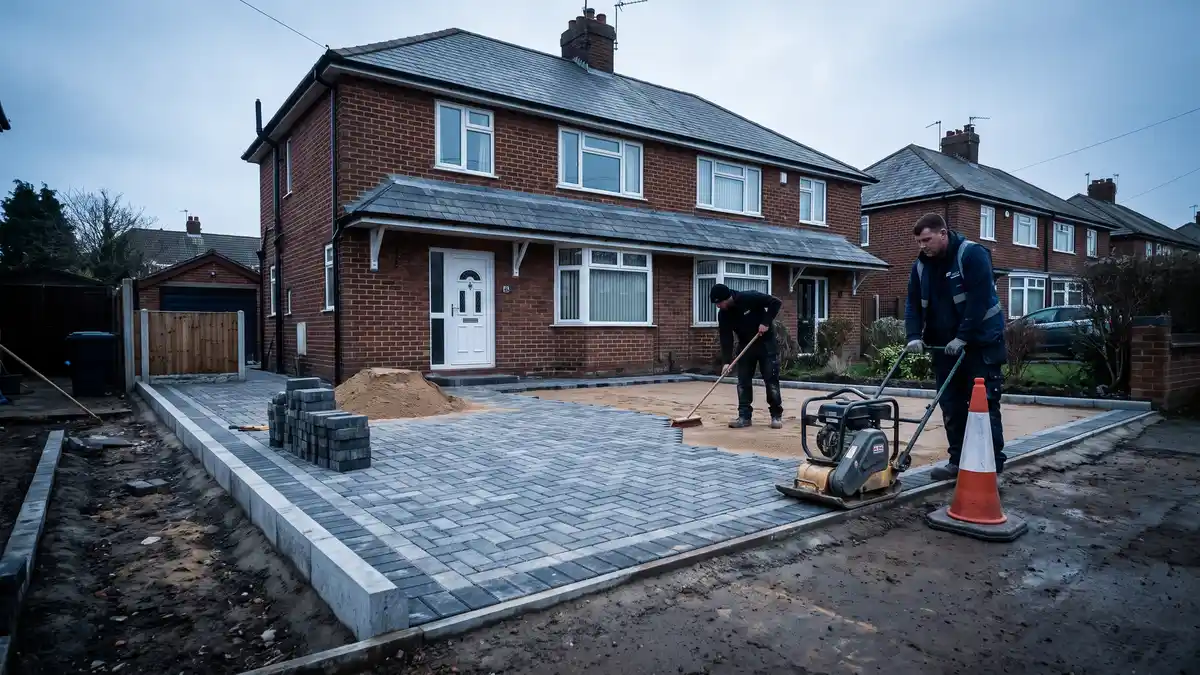
Surfacing wins on this platform for one reason: the finished product is a large, obvious, kerbside change to the front of a house. A resin drive laid on a 1970s estate transforms the appearance of the property from the road, and every neighbour with the same cracked concrete apron sees it every single day. Your advertising job is simply to put that transformation in front of those neighbours on a screen as well as in person, and to do it while the change is still novel.
So the account is organised geographically rather than demographically. Each completed job becomes a micro-campaign: a tight radius around the address, running for three or four weeks from the day the surface cures, with photographs of that specific driveway and a caption that names the road or the estate. Run four or five of these at once and retire them as they age. It is more administrative work than a single always-on campaign and it is worth the difference, because relevance here is literal and local.
Where those campaigns land matters as much as what is in them. A neighbour who taps a photograph of a drive on their own road expects to see twenty more like it within two seconds, which is a website problem rather than an advertising one. A gallery that crawls on a phone undoes the work the advertisement just did, and in surfacing the gallery is the entire sales argument. The same applies to response: an enquiry acknowledged automatically through a CRM within a minute converts far better than one answered when you get off site.
Material deserves its own separation. Resin bound, block paving, pattern imprinted concrete and tarmac attract different buyers at different budgets, and the aesthetic preference is strong enough that showing somebody the wrong surface simply loses them. Resin buyers tend to be further up the budget range and respond to permeability, weed resistance and the seamless finish. Block paving buyers respond to pattern choice and repairability. Tarmac buyers respond to price and speed. One campaign per material, one creative language per campaign.
Two operational cautions. First, seasonality is brutal: resin cannot be laid in the wet or the cold, and advertising hard in January produces enquiries you cannot service until April, by which point they have gone elsewhere. Push budget from late winter into the spring build-up and taper through autumn. Second, this sector attracts rogue operators and homeowners know it, so proof of substance — the sub-base depth, the edging detail, the guarantee, a real address — converts better than any offer. Explaining what a proper base looks like is a genuinely persuasive advertisement in a market full of firms who do not build one.
Audience layers
Three layers doing three different jobs. Skipping the warm and hot layers is why boosted posts disappoint.
| Audience layer | Who is in it | What to show them |
|---|---|---|
| Radius around each finished drive | Half a mile to two miles around every completed job, refreshed monthly, four or five live at a time | That exact driveway, before and after, with the road named. Runs for three or four weeks while the change is still new to people walking past it. Consistently the cheapest enquiries in the account. |
| Material campaign: resin bound | Broad homeowners across your drive-time area, delivery left open, higher-value postcodes weighted only if the data supports it | Permeability, weed and frost behaviour, the seamless finish, and the sub-base beneath it. Resin buyers research the material properly and reward an advertisement that respects that. |
| Material campaign: block paving and tarmac | Same geography, separate budget, separate creative set | Pattern and colour options for block, turnaround speed and price bands for tarmac. Keep the two apart even though the buyers overlap, because the reasons to choose each are opposites. |
| Gallery and quote page visitors, 60 days | Reached a portfolio, pricing or contact page without enquiring, held across a full decision cycle | Substance rather than another photograph: excavation depth, membrane, edging, drainage compliance and what the guarantee actually covers. This is where a serious firm separates itself. |
| Past customers and lookalikes | Customer list uploaded, with a lookalike built from completed installations rather than raw enquiries | Patios, paths, drainage and second phases. A household that surfaced the front drive two years ago is a warm prospect for the back garden and almost never gets asked. |
Running Meta Ads for a driveway companie business already?Send us view access or a screenshot and we will tell you what we would change first, at no charge.
Call 07443 392243WhatsAppBudget and the arithmetic
Driveway accounts scale further than most trades on this platform because the demand is manufactured rather than finite. A single-crew operation usually works well at £700–£1,500 a month of ad spend; firms running three or four crews routinely spend several times that and keep finding buyers, which is the tell-tale sign of a demand-creation market. The constraint is almost never audience size. It is installation capacity and the weather.
Work the arithmetic from contribution rather than turnover. A resin drive commonly runs into four figures with materials and labour taking a large share, so the money available to buy a customer is a slice of the job, not the job. Decide that slice deliberately, divide by your quote-to-job conversion rate, and you have a cost-per-enquiry ceiling you can actually manage against. Firms that skip this step end up chasing a cheap cost per lead and wondering why the diary is full of unconverted site visits.
Expect the enquiries to be more variable than search enquiries. Someone who typed the word driveway into Google has decided; someone who tapped an instant form during an advertisement break may simply have liked the picture. That is the trade you are making, and it is a good trade in this sector because the creation side is so productive. Qualify early, quote fast and keep the two lead sources separated in reporting. The search versus social comparison sets out how differently the two behave, and the cost per lead calculator is the quickest way to see what a lower conversion rate does to an apparently cheap enquiry.
Four ways this goes wrong
- Running one generic driveway campaign across the whole county instead of tight radii around finished jobs. Local recognition is the entire mechanism and a county-wide audience throws it away.
- Using supplier photography of resin drives that are not yours. Everyone in the market uses the same images and homeowners have begun to notice.
- Advertising hard through midwinter and booking enquiries you cannot lay for three months. They will not wait and you paid for them.
- Leading on a discount in a sector where the buyer's real fear is being ripped off. A photograph of your sub-base does more than ten per cent off.
- Never advertising back to previous customers, when the patio, path and side access are sitting there unsold.
The two pages behind this one
This page is the intersection. For the wider picture:
Meta Ads in general
Everything about marketing for driveway companies
Questions
Why does the neighbour radius work so much better than targeting?
Because it replaces inference with fact. Interest targeting guesses that somebody might want a driveway. A half-mile radius round a job you have just completed reaches people who live among the same housing stock, of the same age, with the same cracked concrete, and who have physically seen the result on their way to the shops. No audience tool available to you produces a signal that strong.
Should we use instant forms or send people to the website?
Use both, in different places. Instant forms suit the neighbour campaigns, where the ask is small and the interest is fresh, provided you add qualifying questions about approximate size and timescale. Send the material campaigns and everything warm to the site, where the gallery and the build detail can do their work. Whichever you use, ring back within minutes, not days.
How much creative do we need to keep producing?
Realistically one usable set per completed job, which for most firms is a few a week. Before shots from the same position as the after shots, a short clip of the excavation and base going in, and one of the finished surface in daylight. It takes a few minutes on site. The firms that fail on this platform are almost always the ones that stopped taking photographs after month two.
Is Meta better than Google for driveways?
They do different jobs and in this sector social is unusually strong. Search captures the limited number of households who have already decided; social manufactures demand among the far larger group who were putting it off. If you can fund only one and there is visible search volume in your area, start with search because it proves your economics faster. Then fund social, because that is where the ceiling lifts.
Related
Talk to a human
Meta Ads for your driveway companie business
Tell us the area you cover and your average job value. We will say what is realistic before you spend anything.