Meta Ads · Tree Surgeons
Meta Ads for tree surgeons: the job everybody keeps putting off
There is a tree at the bottom of thousands of gardens that the owner has been meaning to deal with for four years. They look at it constantly and have never once searched for an arborist. That gap between daily awareness and zero search activity is exactly the gap paid social exists to close.
In short
Meta Ads for tree surgeons in the UK needs a different build from a generic Meta Ads account, and this is how PipelineOS structures it. Split the trade in two before building anything. Storm work, fallen limbs, a trunk across a drive and anything with a safety urgency is search demand: it is typed within minutes and won on availability. The first audience layer is Price transparency, broad local: honest ranges for crown reduction, felling and stump grinding, with the variables named. The most common way this goes wrong: advertising emergency and storm call-outs in a feed.
How we build it
Split the trade in two before building anything. Storm work, fallen limbs, a trunk across a drive and anything with a safety urgency is search demand: it is typed within minutes and won on availability. Planned work — crown reduction, thinning, large-tree felling, hedge reduction, stump grinding and seasonal maintenance — is the opposite. It is noticed constantly and deferred indefinitely, usually because the owner has no idea what it costs or whether they are allowed to do it. Both of those obstacles are solvable in an advertisement.
Price uncertainty is the bigger of the two. Homeowners systematically overestimate tree work, often by a large multiple, and that overestimate is the reason they never enquire. An advertisement giving honest ranges for common jobs, with the caveats stated, removes the obstacle for a substantial part of the audience at a stroke. It also filters out the people whose expectations were never going to survive a quotation, which saves your time.
Permission uncertainty is the other and is genuinely under-exploited. Tree preservation orders and conservation area notification requirements are widely half-understood, and a homeowner who suspects they might not be allowed to touch a tree frequently does nothing at all rather than risk it. Content that explains how to check, what notice periods apply and that you handle the paperwork converts unusually well, because you are removing a barrier nobody else in the feed is even acknowledging. Keep it accurate and point people at their own council.
Both of those subjects are worth writing up properly on the site as well as running as advertisements, because they are also what people type when they finally do search. That overlap is unusual and useful: the same material earns its keep twice, once in the feed and once through organic search.
Seasonally, run against the obvious. Most firms advertise in autumn when everybody else does and the auction is dear. There is sustained work available in late winter, when the structure of a bare tree is visible and the owner is looking straight at it, and in spring before the nesting-season constraints tighten. Aim the creative at what the person can see from the kitchen window at that point in the year, which is a more useful targeting instrument than any interest category on the platform.
Audience layers
Three layers doing three different jobs. Skipping the warm and hot layers is why boosted posts disappoint.
| Audience layer | Who is in it | What to show them |
|---|---|---|
| Price transparency, broad local | Homeowners across your working radius, broad delivery, no interest layers | Honest ranges for crown reduction, felling and stump grinding, with the variables named. Removes the single biggest reason a deferred job stays deferred. Expect this to be the volume campaign. |
| Permissions and protected trees | Same broad local audience, run as a separate lower-budget campaign | How to check for a preservation order, what conservation area notice means, and that you handle the submission. Nobody else is addressing this and it converts well above its impression share. |
| Radius around visible jobs | A tight radius around each site where you have taken down or reduced something substantial, run for two to three weeks after | The tree before and after, from the road. A large removal is visible for streets and every neighbour with an overgrown boundary notices. Rotate as the jobs rotate. |
| Seasonal maintenance and hedges | Broad local, weighted into late winter and early spring rather than the crowded autumn window | Bare-structure work, hedge reduction before nesting constraints, and orchard or fruit tree pruning. Cheaper auction, clearer visual reason, less competition. |
| Site visitors and past customers, 60 days | Read a service page without enquiring, plus your own customer list for repeat maintenance | Insurance cover, qualifications, waste removal and what the garden looks like when you leave. Trees are done close to houses and the real anxiety is damage and mess. |
Running Meta Ads for a tree surgeon business already?Send us view access or a screenshot and we will tell you what we would change first, at no charge.
Call 07443 392243WhatsAppBudget and the arithmetic
A two or three person outfit typically works at £300–£1,000 a month of ad spend, and the channel scales beyond that only as far as your climbing capacity allows. Tree work is capacity-limited in a way that rewards restraint: generating more enquiries than you can quote produces slow responses and poor reviews, which costs more than the extra jobs are worth.
Value varies enormously across the work, from a modest hedge cut to a several-thousand-pound dismantle over a conservatory, so set your cost-per-enquiry tolerance against your realistic average rather than against the best job you did last year. The bigger lever in this trade is usually conversion rather than acquisition: most arborists quote on site, and the gap between quoting within forty-eight hours and quoting within a fortnight is worth more than any bid adjustment. Automating the acknowledgement and the follow-up through your CRM is the cheapest improvement available.
Expect these enquiries to behave differently from search enquiries, because the person was not looking. They ask more questions, take longer to commit and need more reassurance about insurance and mess. That is the cost of demand creation and it is worth paying in this trade, because the alternative is waiting for a market that only exists when the wind blows. Keep the two sources separate in reporting so you can see the difference rather than guessing at it, and compare the shape of them on the search and social comparison.
Four ways this goes wrong
- Advertising emergency and storm call-outs in a feed. That demand is typed within minutes of the branch coming down and you will never be there in time.
- Refusing to put any price guidance in the advertisement, when wildly overestimated cost is the main reason the job has been deferred for years.
- Advertising hardest in autumn alongside every other firm, instead of working the cheaper late winter and early spring windows.
- Ignoring tree preservation orders and conservation areas as a subject, when uncertainty about permission stops a large number of enquiries before they start.
- Generating more enquiries than the team can quote within a few days, which turns a good month into poor reviews and slow responses.
The two pages behind this one
This page is the intersection. For the wider picture:
Meta Ads in general
Everything about marketing for tree surgeons
Questions
Why advertise prices when competitors do not?
Because the barrier here is not choosing between arborists, it is the homeowner's belief that the job will cost far more than it will. Ranges with the variables named convert that belief into an enquiry. You lose a few people who wanted it done for nothing, which is a saving rather than a loss, and you reach a much larger group who had written the job off entirely.
Does the neighbour radius really work for tree work?
It works well, though differently from trades with a kerbside finish. A large removal or a significant reduction is visible from a long way and changes the light in several gardens, so the audience has usually noticed the work before it sees the advertisement. Run it for two or three weeks after the job while the change is fresh, then move the radius to the next site.
What about commercial and council contracts?
Those are won on tendering, accreditation and relationships, and no amount of feed advertising shortens that. The value of a visible, professional social presence to a commercial buyer is reputational: it supports a decision made elsewhere. Do not fund a campaign expecting commercial enquiries from it, and do not let an agency sell you one that promises them.
How much creative does this need?
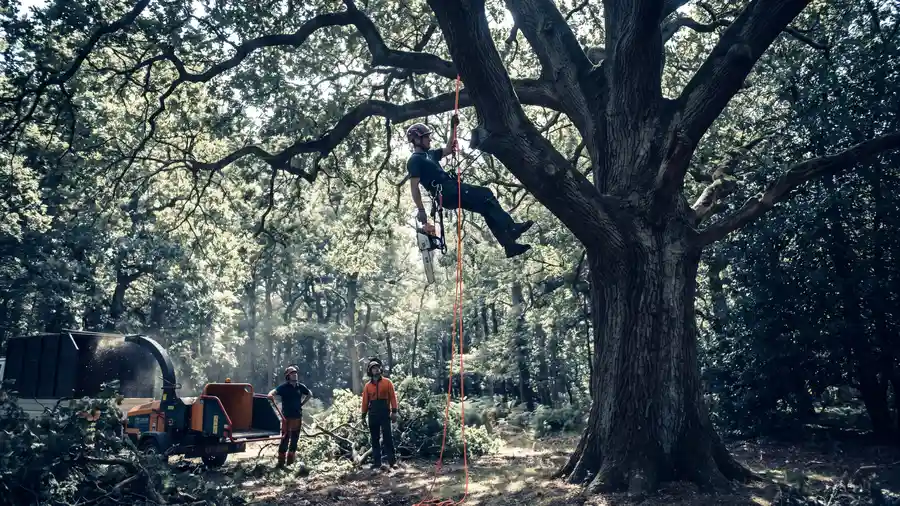
Less than most trades, because the same price guidance and permissions material stays relevant for months. What does need refreshing is the job footage: a section of trunk coming down on ropes is genuinely compelling and takes thirty seconds to film. One decent clip a fortnight, plus a before and after from each substantial job, keeps a tree surgery account supplied.
Related
Talk to a human
Meta Ads for your tree surgeon business
Tell us the area you cover and your average job value. We will say what is realistic before you spend anything.