Sheffield
Marketing agency for Sheffield trade & construction firms
Sheffield is the only big English city where the gradient of a street changes what a job costs, and most marketing for trade firms here ignores that completely. We are based in Hampshire and work with Sheffield firms remotely — calls, shared dashboards and email — rather than implying a northern office we do not have.
In short
PipelineOS is a UK lead generation agency working in Sheffield, running Google Ads, Meta Ads, SEO and AI search for trade and construction firms there. Steel did not leave Sheffield, it got smaller and much more advanced. The modern industry is specialist alloys, forging and precision engineering, concentrated along the Don valley and out towards Rotherham, with a research and manufacturing campus attached to the universities that has pulled in aerospace and automotive engineering work. Sheffield is a comparatively gentle auction for a city of its size. Stone roofing and masonry is one of the stronger trades in Sheffield: local stone slate and gritstone construction across the western suburbs needs materials and skills that standard roofers do not carry.
A city on a gradient, built in stone
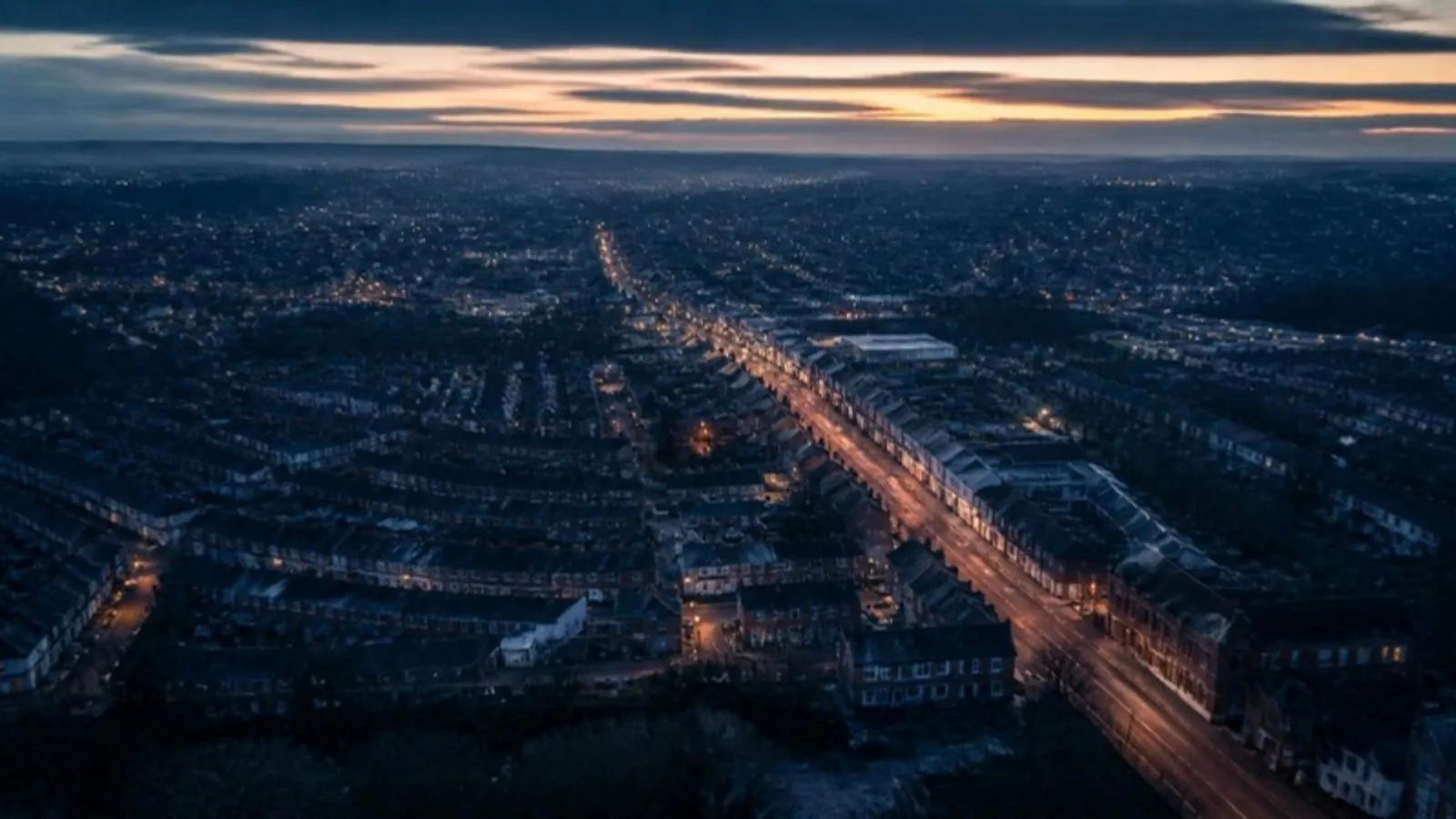
Sheffield is built across steep ground, and that single fact runs through its trade economy. Crookes, Walkley, Nether Edge, Heeley, Stannington and Gleadless all sit on slopes sharp enough to change how work is priced: scaffold on falling ground needs longer legs, base adjustment and often a longer hire; skips and deliveries have to be placed rather than dropped; and rear access down a bank can mean barrowing every bag of muck out through the house. The gradient also creates work that flatter cities barely have — retaining walls between gardens and along back lanes, stepped terracing, cellar rooms cut into the hillside that take water through the uphill wall, and driveways that need levels solving before they need surfacing. Firms that price access honestly at survey stage, instead of discovering it on the Monday, are the ones that get recommended.
The stock is largely stone and brick Victorian terrace with substantial interwar and post-war municipal estates behind it — Parson Cross, Manor, Arbourthorne and Gleadless Valley — and that mix produces two separate demand lines. The older housing wants lime repointing, stone repair to lintels and mullions, natural slate and chimney work. The estate stock wants re-roofing, window replacement, rewires and heating. Around them sit a very large student rental belt through Broomhill, Crookesmoor and the Ecclesall Road corridor serving two universities, affluent western suburbs at Dore, Fulwood and Ranmoor that buy planned improvement, and a light industrial corridor down the Lower Don Valley through Attercliffe and Tinsley that keeps commercial roofing, cladding and surfacing moving.
Cheap clicks and a shallow field
Sheffield is one of the least expensive major paid search markets in England for trade terms, and the agency population is modest compared with Leeds or Manchester an hour away. Head terms are held by long-established family firms with deep review counts but thin, dated websites, and directories still occupy visible positions — usually a sign the organic field is beatable by a real business willing to publish properly.
The openings are specific. Almost nobody writes about access and gradient, which is the question every Sheffield homeowner on a hill actually has. Stone and lime content is similarly unserved. Rotherham, Barnsley, Chesterfield and Dronfield search separately and more cheaply again. And because clicks are cheap, paid search here can be used to test which services and which districts convert before committing to a longer content programme, which is not affordable in the South East.
What we would prioritise in Sheffield
- Make access the argument. Scaffold, retaining walls and hillside cellars are real buying questions nobody answers online here.
- Split stone stock from estate stock. Lime and slate work and bulk re-roofing are different services sold to different people.
- Use cheap clicks to learn. Test districts and services in paid, then build content around whatever actually converts.
- Work the wider South Yorkshire field. Rotherham, Barnsley, Chesterfield and Dronfield are quieter markets in their own right.
Trades we know best
Scaffolding · Roofing · Glazing · Construction & groundworks
What actually drives trade demand in Sheffield
Steel did not leave Sheffield, it got smaller and much more advanced. The modern industry is specialist alloys, forging and precision engineering, concentrated along the Don valley and out towards Rotherham, with a research and manufacturing campus attached to the universities that has pulled in aerospace and automotive engineering work. That is a serious industrial estate to maintain, and it buys roofing, cladding, mechanical services and surfacing on programme.
The two universities together give the city one of the largest student populations in the country relative to its size, which has produced both a huge purpose-built accommodation sector and an extensive shared housing belt through Broomhill, Crookes and Ecclesall Road. Health is the other major employer, with teaching hospitals and associated research adding a further institutional estate.
Domestic Sheffield divides sharply. The west and south-west carry substantial Victorian and Edwardian villas and stone terraces with real money behind them. The east and north carry post-war and municipal stock with far lower values and a repair-led spending pattern. A firm needs to know which half of the city it is selling to, because the same advert cannot address both credibly.
The competitive picture
Sheffield is a comparatively gentle auction for a city of its size. It has a smaller agency population than Leeds or Manchester, and a good number of established trade firms still rely largely on reputation and a basic website, which leaves the search results softer than the population would suggest. The usual caveat applies: no independent published source gives verified click costs by city, so this is a relative reading rather than a measurement.
Where competition bites is on stone and heritage work, where a small number of genuinely skilled firms have long-standing reputations that advertising will not displace quickly. Aggregators concentrate on the commodity trades and largely ignore anything requiring a survey. For most firms the best value is in the suburban and satellite terms, and in the Rotherham, Chesterfield and Barnsley markets which sit adjacent and cheaper again.
Working radius
Sheffield is a hill city and journeys take longer than the map suggests, with gradients that make winter access genuinely unreliable on some roads. The M1 runs down the eastern edge, which makes Rotherham, Chesterfield, Barnsley and Doncaster easy, but travelling west means climbing, and beyond the city boundary you are quickly into open moorland rather than another town. The practical catchment is a fan pointing east.
Which trades do well here
| Trade | Why, in this city specifically |
|---|---|
| Stone roofing and masonry | Local stone slate and gritstone construction across the western suburbs needs materials and skills that standard roofers do not carry. |
| Student housing maintenance | One of the largest student populations in Britain generates continuous between-tenancy and compliance work at predictable times of year. |
| Industrial roofing and cladding | Advanced manufacturing along the Don valley operates from large-format buildings maintained on planned cycles. |
| Retaining walls and drainage | Steep sites and heavy surface water make slope stabilisation and drainage design a routine rather than occasional requirement. |
| Loft and cellar conversion | Large Victorian houses in the western suburbs offer generous conversion potential to owners who cannot easily buy bigger nearby. |
A substantial part of Sheffield lies inside a national park, which is not true of any other major English city. The western edge of the built-up area runs straight into protected moorland, and that brings planning constraint, material expectations and access limitations to properties that are otherwise ordinary suburban houses. It also means a firm here can be twenty minutes from a steelworks and twenty minutes from a farmhouse with no mains drainage, and needs two entirely different sets of answers ready.
Questions from Sheffield businesses
Are you actually based near Sheffield?
No, and we would rather say so than pretend. We are in Chandler's Ford, Hampshire, and we work with Sheffield firms remotely — which is how search advertising and SEO are run in any case, because the account does not care where the person managing it sits. What we do not have is an office in Sheffield or someone who can be on your site on Tuesday. If that matters to you, hire locally, and we will say the same on the phone.
Do I have to sign a contract?
No. Everything ongoing is month to month. If a month goes badly you can leave, which is a considerably stronger incentive for us to perform than a twelve-month contract would be. You also keep every account, asset and file on the way out.
Who actually does the work?
One person, and you speak to him. There is no media buying team and no account management layer, which caps how big this can get and means the person who sold you the work is the person in the account on a Tuesday morning.
Will you work with a competitor of mine?
Not in the same trade in the same area at the same time. If we are already running a roofer in your patch we will tell you on the first call rather than take both and quietly bid you against each other.
Other areas we cover
Fifteen cities, not four hundred towns. Generating a page for every settlement in Britain takes about ten minutes and is worth nothing — Google has treated that as spam since 2024, and pages like it routinely fail to rank even for their own exact-match title. These are markets we can say something true about. We work with clients across the whole UK and Ireland whether or not their city appears here.
Talk to a human
Working in Sheffield?
Tell us your trade, your average job value and the area you actually want work from. Two minutes is usually enough for a straight answer.